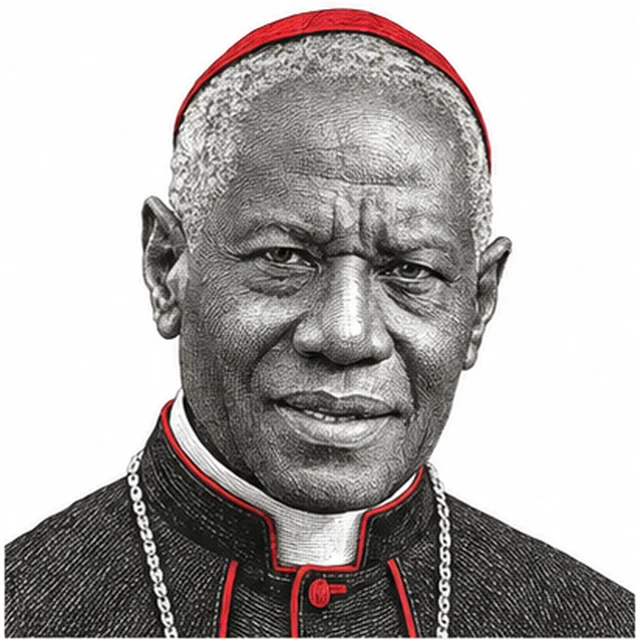
Non-elector · Papabile
Robert Sarah
Guinean cardinal, former prefect of the Dicastery for Divine Worship, known for his very conservative positions on liturgy and doctrine, and his deep attachment to Catholic tradition.
- Country
- Guinea
- Born
- 15 June 1945 (81 years)
- Created cardinal
- by Benedict XVI, on 20 November 2010
- Status
- Non-elector: aged 80 or over, he no longer votes in a conclave but takes part in the general congregations
Overall position 90/100 · Very conservative
Positions on six themes
How are these scores established?Each theme is scored from 0 (very progressive) to 10 (very conservative). The overall score, out of 100, weights the six themes.
-
Moral doctrine · 25 %
10/10Cardinal Sarah is an outspoken defender of traditional Catholic moral teaching. In a message dated 6 January 2024 he called Fiducia Supplicans a 'heresy' that 'seriously undermines the Church', said that people in same-sex unions should be called to conversion rather than blessed, and urged bishops to follow the African episcopal conferences that restricted such blessings. In 2025 he again described the declaration as 'theologically weak and therefore unjustified'. He says he is opposing a text, not the pope.
-
Liturgy and tradition · 20 %
10/10Cardinal Sarah, former prefect of the Congregation for Divine Worship, is among the best-known defenders of the traditional liturgy. In an August 2026 interview with Il Giornale he said Traditionis Custodes was neither 'sensible' nor 'respectful', praised Benedict XVI's Summorum Pontificum, and argued that wider access to the older form had helped the celebration of the ordinary form. In 2025 he asked whether a rite of more than a thousand years can be 'banned'.
Sources (3)
-
Socio-political engagement · 15 %
8/10In a March 2019 interview Cardinal Sarah described mass migration as a 'new form of slavery' and said that using Scripture to promote it is a false exegesis, arguing that people should be helped to flourish in their own cultures. He also criticised the European Union and Western secular trends. In 2024 he said that 'the Church in Africa is the voice of the poor, the simple and the small'. He has made fewer public statements on ecology or the death penalty.
-
Stance on Francis's reforms · 20 %
9/10Cardinal Sarah has publicly criticised several decisions of Pope Francis, including Fiducia Supplicans and the restrictions on the traditional Mass, and in January 2020 published a book defending priestly celibacy with Benedict XVI while Francis was weighing the Amazon synod proposals. On synodality he says communion is an end and synodality 'a means, to be verified'. He insists he is not opposing the pope, and in 2025 he said he looks to Pope Leo XIV with 'great confidence'.
Sources (3)
- Retired pope, Vatican cardinal write book defending priestly celibacy — Catholic Review / Catholic News Service, 2020-01-13
- Pope Leo XIV Receives Cardinal Sarah in Private Audience — National Catholic Register, 2025-09-22
- Il cardinale Sarah e i suoi 80 anni: «Guardo con fiducia a Leone XIV» — Avvenire, 2025-09-11
-
Interreligious dialogue · 10 %
8/10Cardinal Sarah stresses Christian identity and mission. In a 2019 interview he grouped Islamism with materialism as forces that separate people from God, while rejecting violence in God's name, and said the Church 'imposes nothing; she only proposes'. On ecumenism, he said in February 2024 that division among Christians undermines their witness, and that prayer and fasting against shared evils can include people of other religious traditions. No personal initiative on interreligious dialogue, such as the Abu Dhabi Document, has been found.
-
Communication and pastoral style · 10 %
7/10Cardinal Sarah's style is classical, doctrinal and spiritual, expressed mainly through books, long interviews with Catholic and conservative outlets and addresses to bishops and clergy. He uses forceful language on topics such as practical atheism and Western secular trends. He is far from absent from the media, but his register is traditional rather than new or populist.
Career
- 1979 – 2001Archbishop of the Roman Catholic Archdiocese of Conakry
- 1979 – 1993Apostolic administrator
- 2001 – 2010Vice Grand Chancellor of the Pontifical Urbaniana University
- 2010 – 2021Cardinal-deacon
- 2014 – 2021Prefect of the Congregation for Divine Worship and the Discipline of the Sacraments
- since 2021Cardinal priest
- Episcopal consecration
- 13 August 1979
- Consecrators
- Giovanni Benelli, Jean Pierre Marie Orchampt, Luc Sangaré
- Languages spoken
- English, French, Italian
Official documents
- Letter of the Prefect of the Congregation for Divine Worship and the Discipline of the Sacraments to the Presidents of the Conferences of Bishops on the invocations “Mater misericordiæ”, “Mater spei”, and “Solacium migrantium”to be inserted into the Litany of Loreto
- Decree on the inscription of the Celebration of Saint Paul VI, Pope, in the General Roman Calendar (25 January 2019)
- Decree on the celebration of the Blessed Virgin Mary Mother of the Church in the General Roman Calendar (11 February 2018)
- Circular letter to Bishops on the bread and wine for the Eucharist - Congregation for Divine Worship and the Discipline of the Sacraments (15 June 2017)
- The liturgical memory of Mary Magdalene becomes a feast, like that of the other apostles
Why he is mentioned among the papabili
Career and Functions
Born on June 15, 1945, in Ourous, Guinea, Robert Sarah was ordained a priest in 1969. At 34, in 1979, he became the Archbishop of Conakry, the youngest Catholic bishop at the time. He held this position until 2001, during which he resisted the Marxist regime of Sékou Touré, defending religious freedom and the autonomy of the Church. (Cardinal Robert Sarah: A Leading Contender for the Pope Office, Pope Francis accepts Cardinal Robert Sarah's resignation from ...)
In 2001, he was appointed Secretary of the Congregation for the Evangelization of Peoples, then President of the Pontifical Council Cor Unum in 2010. That same year, he was created cardinal by Benedict XVI. In 2014, Pope Francis appointed him Prefect of the Congregation for Divine Worship and the Discipline of the Sacraments, a position he held until his retirement in 2021. (Pope Francis accepts Cardinal Robert Sarah's resignation from ..., 14 cardinals will no longer be electors at the end of 2025 - Aleteia, Le cardinal Sarah ne sera bientôt plus électeur du Conclave - Aleteia)
Author of several influential works such as God or Nothing (2015), The Power of Silence (2016), and The Day Is Now Far Spent (2019), he is recognized for his defense of the traditional values of the Church.
Analysis of his chances of election as pope
Strengths and assets
Experience and international stature: With more than 40 years of episcopal service and key positions at the Vatican, he has a deep knowledge of the universal Church.
Respected spiritual figure: His writings and positions make him a reference for many faithful attached to tradition.
Symbol of universality: His election would mark a historic turning point as the first African pope in centuries. (Cardinal Robert Sarah: A Leading Contender for the Pope Office)
Weaknesses and limiting factors
Advanced age: He will be 80 on June 15, 2025, which limits the potential duration of his pontificate. (Cardinal Robert Sarah: A Leading Contender for the Pope Office)
Conservative positioning: His strong positions on sensitive issues may raise reluctance among more progressive cardinals.
Relations with Pope Francis: Although he has always affirmed his loyalty, some of his interventions have been perceived as critical of Pope Francis's orientations.
Ideological positioning
Cardinal Sarah is identified as a conservative figure, attached to traditional liturgy and the Church's classical moral teachings. He criticizes secularization and defends a vision of the Church centered on prayer, silence, and doctrinal fidelity.
Network and weight within the College of Cardinals
He has the support of cardinals who share his traditional convictions, particularly in Africa and Europe. However, the majority of cardinal electors having been created by Pope Francis, his influence could be limited compared to candidates more aligned with recent reforms.
To learn more:
Le cardinal Sarah ne sera bientôt plus électeur du Conclave – Aleteia
Pope Francis accepts Cardinal Robert Sarah's resignation from divine worship congregation – Catholic News Agency
Sarah for Pope – Crisis Magazine
Robert Sarah – Wikipedia


